Showing posts with label Editorial. Show all posts

Tuesday, 3 May 2022

Problems

This Bastionland Editorial was originally sent as a reward to all Patreon supporters, and is released freely on this site a week after its original publication.

If you want to support my blog, podcasts, and video content then head over to my Patreon.

-----------------------------

I like encounters that are a problem with a problem throwing problems.

Wait! Hear me out.

Okay, let's assume we're talking about a classic monster encounter that at least has potential to be antagonistic, and think of it this way instead:

  • The encounter poses a defining problem to the players (the troll is blocking our route into the deeper caves)
  • The encounter has personal problems of its own (the neighbouring kobolds are making a racket, disturbing its hibernation)
  • Engaging with the encounter causes dynamic problems that need responding to (you cut off the the troll's head but it gradually begins to grow back. The tiny head starts barfing acidic bile around the room, what do you do?)

Defining Problems

This is the reason for tension in the encounter. Why is this thing a problem at all, rather than just something existing alongside you? Monsters blocking the way is obvious, but you might have encounters that are working against you in less obvious ways (this goblin is following us around but we don't know why). 

Personal Problems

This is the "why" of the encounter, flipped to their perspective. It can be blunt, like a Beholder that finds themselves disgusting at all other beings, or more complex, like a golem that's been bound into performing a likely impossible and very specifically worded task.

Dynamic Problems

These are the turn-by-turn problems that usually emerge if things turn to combat. It's a solid rule of thumb to have each round of combat feel different to the last somehow, and good encounters give you the tools you need to do this without too much forced-feeling improvisation. Remember, the point of these is to create interesting "what do you do?" moments for the players, so things like winding up for a huge attack are often more interesting than the attack itself. 

Standard Caveat

As with all of these guidelines, I wouldn't hold myself to following them to the letter 100% of the time. Maybe that Black Pudding doesn't need to have a personal problem... but at the very least it's useful to think about its wants and needs, however simple, and keep them in mind when running the encounter. Sometimes "hungry, drawn to warm flesh" is more than enough. 


Thursday, 14 April 2022

Patching

This Bastionland Editorial was originally sent as a reward to all Patreon supporters, and is released freely on this site a week after its original publication.

If you want to support my blog, podcasts, and video content then head over to my Patreon.

-----------------------------

Calendars aren't my strong suit, but if this is Editorial #52 then I make that a (nearly) full year of doing these things (just conveniently ignoring those weeks that I skipped). I was initially hesitant about having my regular content on a delayed release for non-patrons, but it seems to have worked quite well. The only downside is that I change my mind so quickly that often the ideas I'm sharing are out of date by the time they hit the public blog. 

So let's see if I can make it to 100. 

Ben Milton's Glatisant Newsletter got me onto reading about Blorb Principles for running an RPG. Whether or not this particular style of play suits you, this principle-setting is a useful tool for focusing in on what elements you really want to keep in mind when running or playing a game. Better still, a shared set of principles for the table avoids those issues where the game drastically misses the expectations of one or more players. 

So, yes. Set principles. I think it's worth doing.

But what about this Blorb thing? I'm not going to repeat everything that's been written already, but it largely fits with my own style of play. In particular there's one section that nicely distills something I've never quite managed to put into words before. 

Quoted here (but you should absolutely go and read the full post): 

Three Tiers of Truth

The DM is asked a question like, for example: what’s in the office?

a. Look in the prep. Maybe this room is in there and the text says what is canonically in there, and you’re all set.

b. Otherwise, maybe you have a rule (“default offices have a stapler, a typewriter, a visitor’s chair” etc) or mechanic (such as a random room content table). Use that.

c. If you don’t have that either, make something up. Try to make it something that won’t help or harm the players too much. It can be evocative and build mood, but shouldn’t be 20 angry beholders (or 20 free healing potions). Don’t feel bad: allowing DMs to start small is how we get new DMs. But, patch the hole, or this category of holes, for future sessions. Then over time your DMing will get more and more solid.

Always work in that order, top to bottom, only falling to a lower tier of truth when you have to.

A campaign that’s built on all T2 and T3 truths isn’t as engaging as one that has some solid T1 framework in there (in a cloud, bones of steel), but as you patch holes (as T3 instructs you to) feel free to patch them with mechanics and general solutions (i.e. T2 truths). That’s you building a DM’s toolbox.

Yeah, of course I like the bit that essentially fits into a 3-bullet procedure. I've lingered around the idea of the "impartial GM" before, but never really committed too hard to it. This feels like a good, practical structure to put that idea into practice. 

But of course I need to make some initialism or acronym in order to wedge this into my brain, so I'm remembering the three tiers of truth as:

1: Prep
2: Procedure
3: Patch

The first two should be pretty self-explanatory. 

1: If it's written in your notes then don't change it because of stuff the players have done ahead of encountering it. This goes back to the quantum ogre and beyond, so not much for me to add here. 

2: If it's not in your notes and you have a rule or roll somewhere that's fit for purpose then use that to generate a new truth. All part of the appeal of encounter rolls, reaction rolls, morale checks. The stuff that makes the world feel dynamic and real even outside of the GM's notes. I'll stress here that there's a huge difference between "making a world feel real" and "making a realistic world" but that's one for another day. 

3: This is the one that I want to give more thought to. That essential GMing skill of making shit up when the players do something you weren't prepared for. I've joked before that this is the most important skill to cultivate, but here it's presented in a slightly more specific way.

You're patching a hole. You're here because you didn't prep for it and you don't have a procedure for it. Now that's not innately bad but on reflection I agree with the Blorb principles that if a game has too much of this I start to lose interest. The curtain starts to fall and the world feels a little less like a living place to explore.

The original principles suggest that you change up your prep to that next time a similar situation arises you can draw on one of the higher tiers of truth, but I'm more interested in the immediate patching that occurs in the gameplay.

In the same way that "describing failure" is trickier and more important than "describing success", I'm starting to think that I want to give more thought to the specifics of how I patch those holes that exist outside of the prep and the procedures. The original post has some good advice (don't invent anything too helpful or too harmful) but how about treating it as an opportunity. Just because you're avoiding being especially impactful to the characters doesn't mean you can't have an impact on the players.

Each time I have to patch a hole mid-game I'm going to make something up that checks at least one of the following:

  • Evoke the flavour of the world - the intent being to further solidify their sense of the greater world they're exploring
  • Indulge their senses - shameless attempts at immersion, putting the players right in the minds, ears, and noses of the characters
  • Reinforce something that they've already learned about this place - I'm not 100% sold on this one, as there's a degree of quantum ogre about it, but I also feel like you can never give players too many reminders

So using the original example of the players searching an office that you hadn't planned for, we could patch in three different ways if we were running a game in Bastion:

  • Evoke: The office is a mess. Under the piles of paperwork you can just make out dozens of stacked in-trays and out-trays. The desk is littered with dried up rubber stamps and empty pill bottles. 
  • Indulge: You're hit with the heady smell of correction-fluid, a large bottle of the white chemical spilt on the faded carpet and paperwork scattered throughout. 
  • Reinforce: The office looks abandoned, furnishings thrown to the ground and hastily searched. Presumably whoever looted the other rooms also had a good rummage through here. 

Sure you can shoot for all three at once, but we don't need to apply that level of pressure here. Remember, it's just patching the hole. 


Wednesday, 6 April 2022

Knights

This Bastionland Editorial was originally sent as a reward to all Patreon supporters, and is released freely on this site a week after its original publication.

If you want to support my blog, podcasts, and video content then head over to my Patreon.

-----------------------------


Each Knight has a Shortsword (2d4), Mace (d6), or Axe (d6).

Riding horse (3hp), torches, rope, and dry travel rations.

Specific Knights also receive:

Holdings: The things they own and have access to.

Myths: The truths which are known.


The Moss Knight

The tree and stone did not need to be taught This one knew to study under them

Holdings

  • Wooden Buckler (A1 in Melee)
  • Bag of assorted animal bones
  • Tattoos (see below)

Myths

  • Can speak with uncut stones, but they talk very slowly and are extremely literal
  • When spending the night under a tree it shares a useful vision through dreams, and grants restful sleep
  • After spending a night inside, take the Burden: Stifled: Spend the night in untamed nature.

Tattoos

Colour
1. Faded Black
2. Deep Blue
3. Raised Silver
4. Pale Green
5. Scarred Red
6. Burnt Copper

Design
1. Branching Spirals
2. Tangled Thorns
3. Curved Stars
4. Horned Snakes
5. Twisted Bones
6. Flaming Rings


The Gilded Knight

A beacon of the brave and bold All cloaked and masked in shining gold

Holdings

  • Gold-coloured armour with cloak and masked helm (A1, bulky, opponents who know the value of gold have their first ever attack against you Impaired)
  • Illuminator Globes (cast bright light for a few moments when broken, can be replenished at a secret source)
  • Take the Burden: Symbol: Pass your golden armour onto a worthy successor

Myths

  • When Wounded, all allies fighting alongside regain d6hp
  • When they gain financial wealth, take the Burden: Unworthy: Be rid of your financial wealth
  • When slain, the armour must be cast into darkness. A new Gilded Knight emerges when they are most needed

The Cost

How long has the armour been worn?
1. Days
2. Weeks
3. Months
4. Years
5. Decades
6. For all memory

What was left behind?
1. A Farm 
2. A Crown
3. Only Graves
4. A Student
5. A Teacher
6. A Castle


The Willow Knight

The senior knights fought the storm, falling as broken bones The youth was thrown about, but arose in the calm

Holdings

  • Youthful energy (can be Shattered like a shield)
  • Replace Riding Horse with an Old Grey Charger (1hp, d6 trample)
  • Lyre (only knows sad songs)

Myths

  • As long as they are not wearing Armour any attack dice rolled against them are discarded if they show their highest possible result. Shields do not count as Armour for this purpose.
  • Elders won’t take them seriously at all until their worth is proven.
  • If not carrying any Bulky items they can choose to automatically pass any Save to avoid physical harm, taking the Burden: Unproven: Prove you are worthy being a Knight. 

Memories of Home

Place
1. Riverside
2. Coast
3. Mountain
4. Pine Forest
5. Moor
6. Castle

Disaster
1. Death
2. War
3. Famine
4. Plague
5. Fire
6. Flood

Thursday, 31 March 2022

Mourning

This Bastionland Editorial was originally sent as a reward to all Patreon supporters, and is released freely on this site a week after its original publication.

If you want to support my blog, podcasts, and video content then head over to my Patreon.

-----------------------------

They wandered here and there, drawn out by sorrow

As old as the sun, as timid as a child

Mourning Spirit

STR 5, DEX 15, CHA 17, 3hp.
Flashes of despair (d8 blast), immaterial body (ignores normal weapons).

  • Lingers protectively around a place tied to past sorrows
  • Grants visions of the past sorrows, but only to those who come with peace and humility
  • Repelled by earth from a burial mound, or any funerary imagery

Their World

  • Islands within the mist of time
  • The mourned past can be seen as readily as the now
  • None can die there, but any that leave gain the Burden:
    Haunted: Destroy a part of the past which haunts you.*

MOURNFUL FORMS (Roll 2d6)

Shape 

  1. Robed 
  2. Skeletal
  3. Rotund
  4. Knightly
  5. Childish
  6. Amorphous

Matter

  1. Glow 
  2. Frost 
  3. Fire 
  4. Mist 
  5. Shadow 
  6. Water

*Burdens now function slightly differently to my previous iteration. If you have 3 or more Burdens you are considered Unready, and Burdens can (generally) only be removed by fulfilling their specific requirements. In this case you must "Destroy a part of the past which haunts you".


Wednesday, 23 March 2022

Exploration

This Bastionland Editorial was originally sent as a reward to all Patreon supporters, and is released freely on this site a week after its original publication.

If you want to support my blog, podcasts, and video content then head over to my Patreon.

-----------------------------

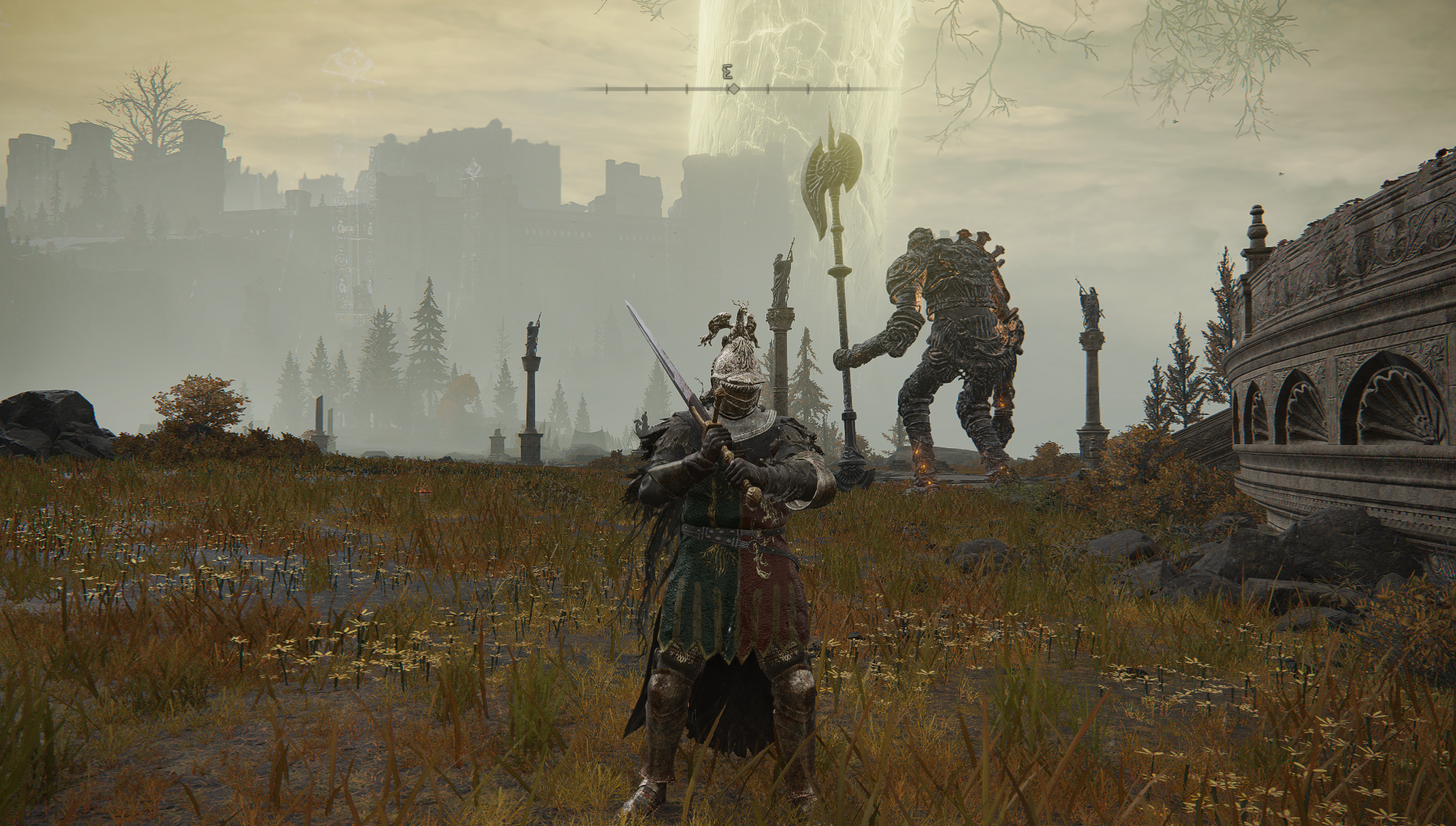
Like so many others I've been playing a lot of Elden Ring over the past few weeks. I'm 27 hours in, and so far it's already been one of my favourite videogame experiences. I played the original Dark Souls 10 years ago, enjoying it but getting stuck at some point and never finishing it. I haven't gone back into the series since, and was mostly drawn into Elden Ring by the comparisons to Breath of the Wild.

Breath of the Wild was the best and worst thing to happen to my experience with videogames. Its inviting world, near limitless freedom, and wide open structure tapped into everything I want from a game, but it lowered my tolerance for games that fail to deliver. Clever systems and finely-tuned challenges are good, but above all else I want to feel like I'm exploring a world in my own way, and that the world is worth exploring. 

Years later I dipped into a remaster of Assassin's Creed: Black Flag hoping for the same feeling, but it always felt like the world was behind a fluttering curtain of systems, and my plans weighed down by a rigid structure for what I should be doing at any given time. No Man's Sky had a lot to like by the time I came to it, but it still felt like there was a game developer's hand on my shoulder as I played. I picked up Shadow of War for free and I don't know if I even made it into the sandbox, dragged down into the tutorial-mire before I could even run freely. 

So I wanted to acknowledge some of the ways in which Elden Ring gets it right for me and nails the element of exploration in a way that so many other games fail. Might be a good checklist if you're hoping to stimulate that same feeling in your tabletop RPG.


It lets me do what I want, not what I should be doing.

It lets me go to dangerous places even if I should probably come back later.

It lets me run away.

It lets me sneak.

It lets me grab some treasure without fighting.

It (usually) shows me the dangerous thing before it kills me.

It shows me big, distant places that I can go to.

It doesn't note down everything for me, and expects me to pay attention.

It sometimes points in a certain direction, but doesn't tell me why.

It lets me visit most regions of the world (perhaps all of them, I'm not sure yet!) without fighting a single boss.

It  puts some weak enemies in the strong areas and some strong enemies in the weak areas. 

It has wandering encounters.

It changes between night and day.

It punishes you for dying, but not too much, and throws you right back in.

It puts some treasure just in a remote place, not necessarily behind a guard. 

It has lore, but most of the time bombards you with flavour.

It has a plot, but it feels more about whatever your character is currently doing.

It lets you change your mind and do something else instead.

It lets me play for 10 minutes or 10 hours and feel satisfied either way.

Perhaps I'll go and dip in right now.

Thursday, 17 March 2022

Myth

This Bastionland Editorial was originally sent as a reward to all Patreon supporters, and is released freely on this site a week after its original publication.

If you want to support my blog, podcasts, and video content then head over to my Patreon.

-----------------------------

I've been pretty vocal about my love of Monster Manuals. I guess I might need to know how many HP a Gorbel has, but I'm really more interested in their weird powers and behaviour. Fire on the Velvet Horizon is essentially an entire book of this stuff.

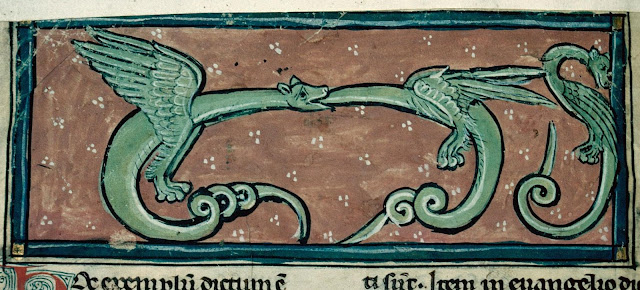
Luckily I'm not alone here, and I've been reading some medieval monk's Fiend Folio knock-off recently. I'd previously assumed that these Bestiaries were full of errors born out of ignorance. "Oh look, isn't it funny how little this 13th Century Scottish recluse knew about giraffes."

Well I'm sure that accounts for some of the content, but here even local fauna is given fantastical qualities, inevitably making some point about Christian vices or virtues. Weasels can resurrect their beloved young, dogs can always be trusted to provide truthful testimony, and goat blood is hot enough to dissolve diamonds. 

I picked up this book as inspiration for a bank of myths I'm writing for my medieval experiment. Whether they're a monster, place, or event, I want these myths to feel mythic. The sort of stories people would tell as allegory in our world, but real in this one. 


THE WYVERN

All jaw and neck like knotted string
All wing and tail with baleful sting

That Twisted, Venomous Reptile
STR 17, DEX 17, CHA 3, 12hp
Cowering wings (A2 when grounded), bite (2d10) or sting (d8, wound causes bloating death within an hour unless thoroughly washed out with fresh milk)

  • A clumsy flier, drawn to places rich with the stench of upcoming death
  • Fights only to secure its nest (see below), protect its young, or for petty revenge
  • Disgusted by the sound of a baby’s cry

Wyvern Eggs

  • The satiated creature lays two eggs among the carrion of battle, without need for a mate
  • Each hatches as a different beast (see right), carrying their mother’s venom
  • The offspring share a feast of the dead before travelling in opposite directions

Her Poisonous Young

Form (d6)
1: Adder
2: Newt
3: Frog
4: Weasel
5: Scorpion
6: Flightless Swan

Abomination (d6)
1: Barbed Scales
2: Unhinged Jaw
3: Prehensile Tongue
4: Bloated Stomach
5: Twin Tails
6: Horned Snout

Tuesday, 8 March 2022

Priceless

This Bastionland Editorial was originally sent as a reward to all Patreon supporters, and is released freely on this site a week after its original publication.

If you want to support my blog, podcasts, and video content then head over to my Patreon.

-----------------------------

Into the Odd, and especially Electric Bastionland, hold personal wealth in high regard. Your debt looms over you, and you're explicitly told to go and hunt treasure to get rich quick. Buying fancier weapons and armour is one of the main ways to improve your survivability, and I wrote the Luxuries section of the equipment list to tempt players into increasingly avaricious ventures.

Playing around with a more mythic-medievally-thing on the same chassis has made me rethink the position of money. Not quite one of those barter systems where people trade rabbits for halberds, but definitely something that would force players to take on a different relationship with money. That is to say I wanted to get rid of it.

As a side note, I want to put some weight on the mythic part of my description above. I love exploring medieval history, but sometimes the legends are even more interesting than the truth. Take Le Mort d'Arthur. It's a book published in the 15th Century, set around the 5th Century, drawing on stories originating from anywhere in between those points. That's before you even get into the various cultures that have thrown their own twists into the tale.  Sub-Romain Britain is fascinating, but Arthurian Britain is enthralling

So what value would this sort of world put on a longsword? You'd better track down a fine blacksmith, there's no call for such an artisan in this sleepy village, so off to a distant castle. Perhaps their liege already has them busy with work, so why should they make a sword for you? Do you try to appease the liege, or strongarm the smith? Maybe you're better off finding a barrow mound rumoured to hold the fine arms from a long-dead warlord.

You don't just go to the shop.

I need to work on this guidance, but I have the seeds of a procedure in place and, for now at least, have removed all references to monetary valuations. 

TRADE Only the rich deal in coins. Most trade in this primeval land is focused on:

  • Finding somebody who can supply the item or service.
  • Making sure they have what they need to provide it.
  • Providing them with one of their needs or wants, or making a firm or implied promise. 

The value of any given item depends entirely on the bargaining positions of the person holding it, and the person desiring it. Long-standing trade agreements often form into pledges of ongoing service or protection.

Naturally, more effective arms and luxurious goods are more difficult to find in supply, and demand more in return.

COMMON ARMS 

Crude Weapon: d6 bulky, pitchfork, staff, etc.
Blade: 2d4, dagger, dirk, etc.
Hand Weapon: d6, axe, spear, etc.
Field Weapon: d8 bulky, pike, bill, etc.
Niche Weapon: d6, bulky, +d8  in a specific situation, torniehook, thistlepole, etc.
Javelin: d6 ranged
Bow: d6 bulky, ranged
Light Shield: +1 Armour in melee
Heavy Shield: +1 Armour, bulky
Field Armour: Armour 1, bulky

RARE ARMS 

Hefty Weapon: d8, waraxe, morningstar, etc
Longsword: 2d6
Greatsword: 2d8 bulky
Greatbow: d8 bulky, ranged
Kite Shield: +1 Armour
Fitted Armour: Armour 1

Note: Weapons listing multiple dice roll and keep the single highest die.

Thursday, 3 March 2022

Tinkering

This Bastionland Editorial was originally sent as a reward to all Patreon supporters, and is released freely on this site a week after its original publication.

If you want to support my blog, podcasts, and video content then head over to my Patreon.

-----------------------------

Just some disjointed ideas today. Messing around with something ITO/EB based. Presented without any further context.

UNREADY: Characters who are caught unprepared, helpless, or  off-guard are Unready, and have 0hp until they ready themselves. Traps usually catch their victims Unready.

BULKY: Bulky weapons require two hands to wield. Anybody carrying 3 or more bulky items is considered Unready.

BURDENS: Characters can acquire Burdens on their soul. These count as a Bulky item. 

RECOVERY: HP is Refreshed by a moment of calm, wiping away the mud and blood. Ability Scores are Restored by a full week of recuperation under warm hospitality. Burdens are Relieved by completing a Quest or taking full season of reflection or indulgence. Other opportunities for recovery may present themselves but carry a cost. 

THE UPPER HAND: Where one side gains an advantage, the Referee grants the most appropriate bonus: +d6: Petty gambit (thrown dust) +d8: Tactical exploit (defensible position) +d10: Ruthless ploy (disarmed target) +d12: Overwhelming force (demon blood)

DIRE STROKE: Before rolling, an attacker can declare a Dire Stroke, making a brutal and ruthless assault. They gain +d10 to their attack but take a Burden. If they shatter their weapon in the process, increase this to +d12.

CATCHING BLOW: When an armed, clawed, or adequately monstrous attacker rolls the maximum possible number on any of their damage die they strike a Catching Blow. The effect depends on whether the attack is Evaded, causes a Scar, Wound, or a Critical Wound. 

EVADED - The target is driven onto their back or into a disadvantageous position. 
SCARRED - The target is enraged and gets +d10 to their next attack.
WOUNDED - The target bleeds, losing a further d6 STR at the end of their next turn unless they stop the flow. 
CRITICAL - The target is slain in a most bloody manner. 

SHATTERED ARMOUR: A combatant can automatically pass a STR Save to avoid a Critical Wound if they declare their shield or armour to be shattered beyond use. This must be declared before the Save is rolled.

Wednesday, 23 February 2022

THE

This Bastionland Editorial was originally sent as a reward to all Patreon supporters, and is released freely on this site a week after its original publication.

If you want to support my blog, podcasts, and video content then head over to my Patreon.

-----------------------------

In among playtesting The Doomed this week, I've been tinkering away on something else. Might not come to anything, but it's been fun so far. 

It leans into the idea that I've seen all over the place, that THE Dragon creates a different expectation than A Dragon, so what if we put THE in front of as many things as possible? I teased this a little with The Legion last week, which was sparked by the idea of The Orc (though weirdly ended up not being just one individual).

So the natural follow-on is...

The Goblin

On toes it creeps, just out of sight A petty hoarder, full of spite

Their Cleverness, the Goblin STR 7, DEX 13, CHA 15, 9hp. Bony needle (d6, +d8 within their Realm), sack of particularly treasured lost things, entourage of lost children and pets.

  • Wants to widen their realm by making things lost, but cannot steal directly.
  • Loves to make unfair trades, but can’t see beyond the short term.
  • Knows how to whisper the right words to a lost thing to hear a clue to the whereabouts of your own missing object. It only works once per object. 

The Realm of Lost Things

  • Tunnels within a pile of bric-a-brac.
  • Only the Lost can enter freely.
  • The Goblin can invite or banish guests.

Thursday, 17 February 2022

123

This Bastionland Editorial was originally sent as a reward to all Patreon supporters, and is released freely on this site a week after its original publication.

If you want to support my blog, podcasts, and video content then head over to my Patreon.

-----------------------------

Continuing from last week's talk of Certainty, I have a very basic combat system you could bolt onto it. Hugely inspired by Skorne, which has recently received a new coat of paint.

All based on a scale of 1, 2, and 3, with those numbers doubled if there's ingenuity or a sacrifice at play. 

Combat

Normal characters have 3 Wounds. At 0 Wounds they are incapacitated. Below 0 Wounds they are dead.

Enemies always act before the players, but the players get a chance to react before it hits. Damage occurs simultaneously.

Damage, Armour & Healing

All three operate on the same scale.

1: Light 2: Heavy 3: Magical

Particular ingenuity or sacrifice doubles the damage of an attack.

Armour absorbs damage from incoming attacks. Heavy armour is awkward, and magical armour always comes with some sort of catch.

Light healing is a day or night of rest. Heavy Healing is professional treatment. Magical always comes with a catch.

Example Monster - THE PIT LEGION

  • The legion grows a new twisted body (3W) each time a soldier dies with fear in their heart. They fear death more than anything. 
  • Their blades and arrows bite (2D) with barbs that prevent natural healing. 
  • Their armour and shields (2A) are dull with rust and mud. After death, they are reborn in The Pit, stronger and scarred.

Thursday, 10 February 2022

Certainty

This Bastionland Editorial was originally sent as a reward to all Patreon supporters, and is released freely on this site a week after its original publication.

If you want to support my blog, podcasts, and video content then head over to my Patreon.

-----------------------------

I often find myself torn between:

  • A love of rolling dice to introduce an unexpected element into the game.
  • The decisiveness of just making a ruling without rolling dice.

So, of course, I exist in a sort of middle ground. I'm not especially drawn to entirely diceless games, but there's an allure to their philosophy of making judgement calls and focusing on adjudication and the grounding of the shared fiction.

Lately I've been especially interested in Sam Doebler's posts on the subject, some of which was put into practice  with the not-actually-diceless Skorne. Jim Parkin's Any Planet is Earth exists in a similar not-diceless niche, acting as one of the big inspirations for Skorne. There's still rolling for success, but some situations (including most of combat) are given the diceless treatment. 

It got me thinking about the classic Oracular Power of Dice idea, and I feel you could have an interesting game that removes dice from the task-resolution process, but keeps them as a way to represent the uncertainty of the fictional world.

You lose that gambler feeling where you stand up for the pivotal roll like you're at a craps table and everybody cheers or groans at the result, but sometimes taking a powerful element like that out of an experience allows other moments to emerge that had been overshadowed by the Vegas-glitz. 

Here's a skeleton of what's been bouncing around in my head. I can already foresee some hurdles, but I'd like to try it out. 

CERTAINTY SYSTEM

In this game, dice are reserved for Oracular purposes, not for Gambling. The GM and players may roll them to unveil truths about the world, but they are never used to determine the success or failure of an action.

Action The GM describes the current situation to the players and asks them to discuss a Plan of action.

The GM should especially consider:

Action - What specifically are they doing? 
Outcome - What does a successful outcome look like for this plan?
Leverage - Why is this plan likely to succeed?

The GM decides which of the following Forecasts best fits the plan:
Blocked - Something is stopping you.
Messy - You'll do it but create another problem or suffer a cost.
Clean - You'll do it, maybe even better than planned.

The GM then describes the Forecast in specifics and the players decide whether to act, modify their plan, or try something different.

Once the action takes place, and the impact occurs, the GM describes the world’s response and the new situation.

Example of Play

GM: As you're searching through the rubble you hear the clattering of a Giant Clawbug crawling toward you. It screeches, its tendril-crowned jaws coming at you.

Player: Right, I'm going to kill this thing with my sword.

GM: Okay, what's your leverage?

Player: I'm good with a sword, got some armour, this thing doesn't look so tough right?

GM: Well you'd need to get close and hack away at it and this thing is dripping with venom. Armour helps against the bites, but its tendrils would writhe through the gaps, so it's still messy. You'd kill it but definitely end up poisoned.

Player: Okay, I'll climb up onto that ledge instead and try throwing some rocks at it. It can't spit venom, right?

GM: What's the outcome you're hoping for?

Player: Just drive it away, I don't really need to kill it.

GM: Okay, that would be clean. You throw a few hefty rocks at the thing and it scurries away in the darkness. The cave is quiet again. 


Thursday, 3 February 2022

Travellite

This Bastionland Editorial was originally sent as a reward to all Patreon supporters, and is released freely on this site a week after its original publication.

If you want to support my blog, podcasts, and video content then head over to my Patreon.

-----------------------------

Okay, this is probably my last post on Classic Traveller for a bit. After the last two editorials covered my initial reaction and further thoughts on the game's crunchier elements, I think we all knew it was going to end with me kludging together a summary of how I'd run the game.

Now the boring answer is that I could just use bits of the book for worldbuilding and character creation, then use some ultralite system like Ask the Stars, 2400, or Any Planet is Earth. But as an experiment, I tried to trim things down as much as I could while maintaining a closer feel to the mechanics of the original. 

Of course I'm 40 years late to the party on this, and there will be much more thoroughly thought-out CT hacks floating around online, but here's mine. 

So here's the core, focused on the nitty gritty of personal combat. Anything not mentioned is carried out as noted in Classic Traveller.

Travellite

Character Creation - Death as Disaster

When you would die during a term of service, Complete the term, but lose d6 from a random attribute (to a minimum of 1) and immediately muster out.

Rolling

Roll 8+ on 2d6 to succeed.

Die Modifiers (DMs) are typically 1, or 3 in extreme cases.

Get positive DMs from:

  • Skills (each point grants +1)
  • High Stat (9 or more grants +1, C(12) or more +3)
  • Help from allies or situation (typically 1, 3 if major or multiple)
  • Weapon

Negative DMs from:

  • Lack of Skill if it's something specialist (1, or 3 if highly specialist)
  • Low Stat (5 or less grants-1, 2 or less -3)
  • Hindrance from situation (typically 1, 3 if major)
  • Shooting at Long (-1) or Very Long (-3) Range
  • Armour

Ignore basically anything else that grants DMs, rolling things like Cover into the situational DM of +/-1 in general or +/-3 in major cases. 

Weapons

Entries are formatted as: Max Range, Damage, Universal DM (if any), Situational DM (if any). Universal and Situational DMs do not stack. 

Hands: S1D, +1 Close (i.e. Short max range, 1D damage, +1DM at Close range)

Beast: S2D, +1 Close

Dagger/Club: S2D, +1 Close

Sword: S2D, +1 Short

Polearm: S3D, -1 Close

Pistol: M2D, +1 Short

Shotgun: M4D, -3 Close

Rifle: V3D, -3 Close

Mods

Heavy:+1D, -1 to all attacks (this stacks with the weapon's DM)

Energy: +1D

Auto: Fire at a close group of 3 targets at -1. Consume more ammo.

Armour

Entries are formatted as: Universal DM, Specialist DM. These do not stack.

Mesh: -1, -3 vs melee (i.e. -1 Universal DM or -3 vs melee attacks)

Ballistic: -1, -3 vs non-energy guns

Reflec: -1, -3 vs energy weapons

Combat: -3

Notes

As you'd expect, this changes the effectiveness of certain weapons in certain situations compared to the original book, but it's a price I'm willing to pay to keep things more transparent and fast-moving. 


Thursday, 27 January 2022

Matrices

This Bastionland Editorial was originally sent as a reward to all Patreon supporters, and is released freely on this site a week after its original publication.

If you want to support my blog, podcasts, and video content then head over to my Patreon.

-----------------------------

Since last week's first dip into Classic Traveller I've gone through the rest of the book pretty much cover to cover.

The Blog Tales to Astound has written the definite series of posts exploring these books in isolation from the rest of the Traveller series. In particular there's a lot of content supporting the fact that the designer, Marc Miller, mostly played a stripped back and improvisational version of the game. 

I think the fact that I'd heard about that before going into the book set me up with a false sense of security. 

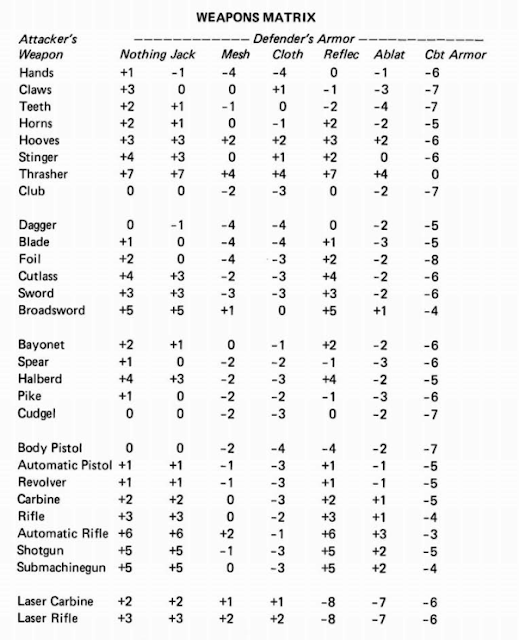
I wasn't ready for the Matrices.

Precise travel times, often down to the second, for 6 measures of acceleration across 22 distances. I can live with that. It's over the top detail but it's useful to know how long these things take.

Jump potential, mass, and build time for 24 classes of jump drive. I mean, the whole ship building system is pretty crunchy, so I feel like this isn't a massive intrusion here.

But the personal combat section is the one that turned me off. At first I see that promising  mechanic that always seems to be lurking in the background here. Roll 2d6, add your modifiers, and aim for 8+.

Add your skill points in your weapon, obviously.

And make sure you apply the right modifiers for having a high enough STR/DEX to make the most of this weapon. The score required and modifier granted depending on weapon, of course. 

Then check the modifier for your weapon at the current range

Then go to a separate table to get a modifier for your weapon against the specific type of armour the target is wearing. 

Oh and subtract 4 if the target is in cover, or 1 if they're in concealment, but only if they've already attacked and revealed themselves. And 3 if you drew your weapon this turn.

Also subtract the target's Blade skill if they're parrying, or a different number for different ranges if they declare they're evading.


It reaches such levels of stacking that I totally understand why so many people run Traveller with "roll 2d6 plus some modifiers based on what the Referee decides". But there's no escaping that this book, rules as written, is one that's going to send you deep into some table to find a precise answer time after time. 

I'm sure it's not that difficult once you've acclimatised to it, and gone through a few combats to get used to things, but it definitely doesn't appeal to me. 

It reminds me of one of my regular design goals of distillation, one of the mantras of which is "Replace rules requiring referencing with principles to internalise". 

I would have much preferred a page of guidance for how to apply referee-adjudicated modifiers in combat. Maybe a checklist of elements to consider when making that ruling?

In spite of all this Matrix-bashing, I can't bring myself to hate on Traveller. Something still draws me in. Maybe next week I'll know what I'm planning to do about that. 

Thursday, 20 January 2022

Travellers

This Bastionland Editorial was originally sent as a reward to all Patreon supporters, and is released freely on this site a week after its original publication.

If you want to support my blog, podcasts, and video content then head over to my Patreon.

-----------------------------

I've never read Traveller. 

This is despite hearing so many people talk about it in response to Foreground Growth and generally liking most of what I hear about it's design and gameplay. 

So today's the day. I ordered a print copy of The Traveller Book, which is the three original books plus a sample adventure. Let's see if there's anything that leaps out at me in the first few pages. 

p9 - This is the first page of proper text and we're introduced to "self-appointed goals", another area that I'm extremely interested in. Great to see it so front-and-center, though admittedly also slightly tucked away in a full page of text.

p10 - "The rules provide for solitaire and unsupervised play, but the highest form of the game, the ones that is the most fun, requires that someone act as referee."

I'm interested to see whether this is expanded on! Also unsupervised play makes it sound like forbidden fruit.

p12 - What makes a good referee? Apparently Imagination, Improvisation, Proportion (being neither over generous or restrictive), and Organisation. Seems pretty good to me, though I think many of us would wince slightly at the last one. 

p13 - Information the GM's setting is advised to be split into four categories, which I'd summarise as:

1: The PCs know it.

2: The PCs can find it out easily.

3: The PCs can find it out with difficulty.

4: The PCs can't find it out by their own efforts.

Whiiiiich, as a "give information" preacher, gives me a little twitch. If you're putting info in your notes that the players stand no chance of discovering, then is that wasted time? I guess it might help with your portrayal of the world to know this huge secret, but I'm not convinced. 

p15 - "One of the most important parts of being a good referee is keeping proper track of the passage of game time."

Hmmmm... this was a real vibe of this era of RPGs.

p18 - So I knew all the jokes about dying in character creation, but by the book it actually looks way more common than I expected! The optional "injury" rule feels much more practical. Perhaps they die on a second injury. 

p19 - "When a character reaches 34 year of age... aging begins to take its toll"

Presented without further comment.

It's around this point that I should confess I'm enjoying this book a lot more than I was expecting. Perhaps that will change as I get beyond the first chapter, but I definitely feel there's something special about this in comparison to other games I've read from the era. 

p21 - I understand that "Gun Combat" and "Gunnery" mean different things, but them both existing as separate skill entries, that actually need to be handled differently, really gives reinforces that old game vibe. It even repeats this with "Blade Combat" and "Blade" as distinct skills!

Melee weapons are handled so weirdly. Maybe it'll make more sense when I read the combat rules, but it essentially seems like there's one ideal weapon for any given STR score, and you should just consult the list to find your dream weapon. With a good STR of 10, my traveller seems destined to wield a halberd or pike, which seems hilarious when I picture them lugging the thing through a space station. 

p22 - Aaaargh! I was just starting to love this system, but now I see that having the skill "Administration 2" doesn't mean a nice simple +2 to your 2d6 roll relating to Administrative Affairs. Nooo, you have to look up each individual skill to find that Administration actually grants +2 for each level of skill, and you get an outright -3 if you lack the skill entirely. Just when I thought we had a nice straightforward system here. Hopefully this isn't a harbinger of things to come. 

I can already sense the distant presence of 40 years' worth of house rules to this game that make things more straightforward, but I can only judge what's in here, for now. Naturally, if I were to run this I'd probably be chopping off a whole lot either way. 

Though for all that I hate the idea of having to consult this skill chapter during play, I kinda love that computers have a 1-in-6 chance of just fatally crashing when needed, and a 27% chance of having a detrimental bug even if it's not fatal. 

Okay, we've hit the end of the character chapter. Feeling very mixed on this. My heart likes it, my head hurts slightly, but let's end by rolling my first ever character.

Major Dunne Reason   887646   30yrs

3 Terms Army  Cr22,000

Brawling -1, Rifle-1, SMG-1, Fwd Obsvr-1, Mechanical-1, Dagger-2

1 High Passage, 1 Mid Passage, 1 Low Passage

Amazing this guy got as far as he did with such a low Education score. Seems like he's mostly good for getting free rides and stabbing people, but it's a start!

Looking forward to seeing what the rest of the book holds. 

Wednesday, 22 December 2021

Attention

This Bastionland Editorial was originally sent as a reward to all Patreon supporters, and is released freely on this site a week after its original publication.

If you want to support my blog, podcasts, and video content then head over to my Patreon.

-----------------------------

So without delving too deep into despair, the pandemic situation here in the UK is looking a bit volatile in the lead up to Christmas, so I'm finding it difficult to focus today. Unfortunate how the negative things can grab your attention like a vice, while the positive things can just as quickly slip through.

Lurching back on-topic, for me this definitely applies to reading and playing RPGs, wargames, boardgames, and especially videogames. Not so much that I get hung up on negatives, but I can find it difficult to focus on a game, even if it's one I'm actively interested in. 

Or, rather, I can focus on the game, but I feel like I'm too busy thinking about the next step. If I'm reading some fluff, I just want to get to the rules. If I'm reading rules, I just want to see how this game actually works in play. Once I get it to play, I often feel it's running too slowly. This might sound terrible, but I've joked before that this impatience is the fuel behind Into the Odd and Electric Bastionland

Blighters comes very much from the same place. I still go back and read Blades in the Dark, because it has some of the best GM advice that I've ever read, but the idea of running it from the book melts my brain. Credit to John for including a section in the book that outright says "you can run this game stripped-back to the core mechanic and it'll work just fine" but why do that instead of spending months carving out my own system?

For those that were interested after this week's post, I'll be sharing a PDF at the start of January when I've been able to tidy it up enough for public consumption. If you read Voidheist then the majority is unchanged from there. 

So to the actual point of this Editorial. For a bit of a change, I'm reaching out to ask for some recommendations from you:

What games (of any type) have you enjoyed that get straight to the point, with minimum padding around its core concept?

Here's hoping we can all find something new to enjoy over the end of the year, and perhaps keep us nicely distracted from the negatives. 


Friday, 17 December 2021

Dragonmeet

This Bastionland Editorial was originally sent as a reward to all Patreon supporters, and is released freely on this site a week after its original publication.

If you want to support my blog, podcasts, and video content then head over to my Patreon.

-----------------------------

Last weekend was Dragonmeet down in London, the first convention I've been able to attend since the release of Electric Bastionland. 

I'll be looking over my haul in this month's Backstage video, but my biggest takeaway is just how good it felt to be able to speak to people that were either already playing the game, or just picking it up that day. Strange that it's almost two years since its release, but actually showing it to people over a table made it feel completely new again. Of course everybody loves the art, but the best feeling is when somebody gets excited by the promise that "this game has the fewest rules-per-pound of any book you'll buy today". 

I was hosted by the always inspirational Rowan, Rook & Decard, and it felt like a good match. Although the rules of our games are significantly different, I think we have a lot of common ground in terms of our approach to setting design and tone. Lots of Spire fans were keen to pick up Electric Bastionland, and vice versa. 

Most of all, I loved spending some time with people I normally only get to interact with though email and social media. You don't need to read another thinkpiece about how the last few years have impacted our real-world social lives compared to those of the digital realm, but it's something I've sorely missed. I've had plenty of good game-chat on Discord, but nothing beats actually talking to somebody over a table full of food, in a quiet hotel corridor, or a freezing smoking area. 

Admittedly I took an hour midway through the day to go and hide alone in my room, but I feel like that's something a lot of attendees would benefit from. 

Who knows what's in the immediate future for conventions like this, but I'm already looking forward to the next opportunity to show somebody Electric Bastionland for the first time.

Friday, 10 December 2021

Countdown Pt2

This Bastionland Editorial was originally sent as a reward to all Patreon supporters, and is released freely on this site a week after its original publication.

If you want to support my blog, podcasts, and video content then head over to my Patreon.

-----------------------------

Okay, let's finish what we started.

#5: A Primordial System (and its Fighter) 

The other big post about this system that I don't fully understand yet. Testing this out at the table is right at the top of my wishlist at the moment, and I'm really excited to see it if holds together. 

Also, this is the most popular content post of 2021! Congrats, Fighter. 

In particular I still really like this approach toward the fighter. I wanted to give them a suite of knowledge that let them feel a little like how the wizard does with magic, or the ranger does with nature. An area that they get to act like a real expert in, rather than just giving them a list of special attacks and bonuses. 

#4: d100 Oddities for New Characters 

From way back in 2016, this thing is still getting lots of attention five years after it was published. So many of these made it into Electric Bastionland, most of them getting polished up a bit beforehand. 

Always feel a sense of achievement with these d100 tables, and this is arguably one of the foundations of what would eventually become Electric Bastionland, so I've got a bit of a soft spot for this one. 

#3: Decisive Combat 

I know this one helped a lot of people to understand how Into the Odd's combat worked, and the reasons behind its design. I still stand by everything in here, and I feel like my impatience with long combats has spread to most other areas of the game. Am I actually getting more impatient, or am I just increasingly aware that things don't need to be so drawn out? I guess some people love a session that's just one combat, or one social encounter, but I most enjoy those sessions that feel like you packed a lot of different stuff into your two hours or so. 

#2: Encouraging Scheming 

This one really surprised me. To be honest, it's not a post that I think about all that often, and I remember at the time I wasn't entirely happy with how it came out. Still, I think it holds up as advice that can be applied to a wide range of games, not just my own. 

#1: Into the Odd Remastered 

Finally, to the surprise of nobody, this announcement post topped out the year. Not much to say about this one, so I'll pivot to giving a massive thankyou to anybody that shared this post around and helped generate so much excitement around this game. 


Friday, 3 December 2021

Countdown Pt1

This Bastionland Editorial was originally sent as a reward to all Patreon supporters, and is released freely on this site a week after its original publication.

If you want to support my blog, podcasts, and video content then head over to my Patreon.

-----------------------------

Is it too early to be talking about end-of-year posts? This has been my second year of working full-time on Bastionland Press, and I'm pleased to look back on a successful Kickstarter campaign and a nearly-finished miniatures game that I'll be handing off to another publisher at the start of next year. Not to mention a whole lot of video content, a podcast series, and of course blogposts. 


The latter is always good fodder for some reflection. In particular, I thought it would be interesting to look back at the ten post popular blogposts over the last year. To clarify, this includes posts from previous years, but I'm always interested to see which posts people are actually reading. 


#10: 100 Interesting Magic Items: The First Half

Guess I was tempting fate with that name. There was never a second half, but I did replace the idea with something else (see #4 when we get to it). This has the honour of being the oldest post in this countdown, now past its 12th birthday. Suppose you could look back at this list as the starting point for what would become Arcana and Oddities. I feel like most of them hold up well enough, but I'm definitely happier with my later item design. Here are a few highlights that I'd still like to use:

Crystal Ship: This miniature ship is beautifully crafted and valuable, but if it is ever taken on board a ship that ship will sink before its voyage is completed.

Death Drum: Anyone that bangs this drum thirteen times or more will die.

Map of the Head: The holder of this map may look over it when trying to remember something they witnessed while carrying the map. Within a minute of looking at it they will remember, even to the smallest detail.


#9: Rules Heavy - Worlds and Classes 

This is the highest ranking post from this year that actually contains game content, rather than some form of announcement. Why did I even bother writing all those articles eh? Apparently I peaked around 2018. 

Coming off the back of a series of Ask the Stars based posts, this is the migration of that idea into that whole Primordial thing that's still floating around in my head and various unfinished documents. Here's hoping 2022 is the year I actually put all that mess to use. 


#8: Into the Odd Announcement 

Ah, clickbait at its finest. No real content or information, just a boring, legally-sound announcement. As so many people guessed, here I was bound by secrecy about Into the Odd Remastered, and wanted to give people a fair chance to pick up the original version, while making it clear that the game wasn't going away. Hopefully nobody felt too cheated by that whole announcement.

Although the midnight announcement sort of fell into place, it's one of my lasting memories of this year. It was an awesome feeling watching the chat as I aired the ITOR Trailer without any introduction. Don't think I could do that for every project, mainly because I'm so bad at keeping secrets, but who knows.


#7: The ICI Doctrine: Information, Choice, Impact 

I recently had a friend ask me for some advice. They were running D&D for the first time, with 5e being their first ever game and having a few months as a player under their belt. I gave them some pretty rambling advice, but later realised I should have just linked them to this post. If there's one post that I still keep in my head when I'm running a game, this is it. 


#6: Three Step Dungeons 

This one surprised me, but I guess people like these sort of processes for their prep. The blank page is terrifying, and anything that aids in getting the skeleton of a game session drawn out is a useful tool. 

Next week I'll look at the top 5!

Friday, 19 November 2021

AAA

This Bastionland Editorial was originally sent as a reward to all Patreon supporters, and is released freely on this site a week after its original publication.

If you want to support my blog, podcasts, and video content then head over to my Patreon.

-----------------------------

This is how far out of the loop I am with big triple-A video games. Yesterday I took a day off after feeling a bit of brain-burn. I fancied some open-world exploration and picked up what I thought was a hot new game from a couple of years ago. 

The game was Assassin's Creed: Black Flag, which is actually like eight years old. 

Still, it's new to me, and this is a remaster at least. I thoroughly enjoyed revisiting my younger years with a full day of just playing a new videogame. Brain healed. 

Overall I enjoyed the game and I look forward to playing it some more. 

BUT who cares about the positives, right? We all want to gripe about how big company makes bad games. So here we go.

Actually, I'm not doing that, but there were a few things that left a bad taste in my mouth, and got me thinking about how those tastes have influenced my approach to running and designing RPGs.

We'll indulge in a little hyperbole, because this is an editorial after all.

Stupid Sideplot Framing Bollocks

So I forgot that this series has a thing where the main portion of the game (roaming around some historical era being an assassin, and in this game a pirate) is framed around a ancestral-memory-regression VR thing set in the near future. Occasionally the game pulls you out of your world of high adventure to put you in a corporate office to endure boring conversations with regular people. Like when you were playing Link to the Past and your aunt and uncle would come around unannounced and your mum makes you come and talk to them about what you're doing at school this week. 

I overuse the phrase "Make the Main Thing the Main Thing" but... just do it for everybody's sake. 

Not Like That!

Mission Failed: You strayed too far from the target.

Desynchronised: Your ancestor did not kill civilians.

This area is unlocked by progressing further in the main story.

You cannot push this door open while the guards are on alert.

It's like the game can't resist reminding you that you're playing a piece of software. I guess here the framing device means you're using a piece of software to pretend you're using another bit of software about being an assassin. This isn't innately bad, but here it's the same feeling of hitting an invisible wall. I see why it's there, but really they could have handled this in much better ways.

If part of your game relies on this sort of clumsy fix then consider fixing the core issue rather than applying a messy bandage on top. 

Yes Your Home is Lovely

Sometimes the game makes you walk really slowly through a very pretty area. The run button is locked, and if you stray too far from an NPC they stop and call for you to come back. I can't help but feel like I'm being expected to ooh and aah. Maybe I will, but maybe just let me explore this world myself, yeah?

Players care more about a world that they discover on their own terms. 

Give Me the Thing or Don't

On the first cutscene of the game I noticed you could hold a button to skip it. Cool, thanks for the heads up but I'll watch this one.

Later on I'm getting impatient and want to get to the mission. This cutscene can't be skipped. It didn't seem to be any more crucial than the others, but maybe I'm missing something. I wouldn't mind if I hadn't been teased with the thing already.

If you're going to include a feature in your game, accept that sometimes the players will use it ways you didn't initially plan for. Instead of hobbling them in its use, maybe rethink the tool itself. 

I know this is a pre-BotW sandbox, and should be viewed accordingly, but sometimes it's hard to go back. 

Friday, 12 November 2021

Relics

This Bastionland Editorial was originally sent as a reward to all Patreon supporters, and is released freely on this site a week after its original publication.

If you want to support my blog, podcasts, and video content then head over to my Patreon.

-----------------------------

After 26 years of distant gazing, tomorrow I'm heading over to Warhammer World in Nottingham to play some Kill Team with Patrick and perhaps a few others. 

I'm looking forward to trying out this new simplified (but by no means simple) version of 40k's skirmish rules, having thrown together a team from the oddballs I have on my shelf, which just about qualifies as legal. 


The Bloodied Birth - Brood Coven Kill Team

My vision manifests into reality. A strong humanity through abandonment of our ancestral shackles.

In generations to come, Fawkes 5 will be revered as the mantle of the Genesplosion, where we pulled ourselves from the slime and the smoke to stand tall.

Without fear, without shame, without the wilful blindness of false faith. By blade and claw and saw we cut down any opposition.

The Bloodied Birth cannot be stopped.

- Catalo Viel, Primonatalus of the Bloodied Birth

Though as much as I'm looking forward to the game, I'm weirdly excited by the prospect of the Exhibition Centre. There are huge dioramas, which will be neat to look at, but mostly I'm craving a peek at some of the surviving miniatures that graced my revered copies of White Dwarf in the 90s. 

Not just some out of print miniatures, but the actual individual miniatures that were on those pages. 

Now I feel like you're either going to relate to that way too much, or give me a look of confusion and pity. Both are equally valid. 

Those miniatures made up the images that got me excited about fantasy and tabletop games, two things that have stuck with me nearly three decades later. I'll spare you the "in the days before the internet..." speech, but you know what I mean. 

Last week I visited the British Library in London and saw the sole surviving manuscript of Sir Gawain and the Green Knight alongside one of the four surviving copies of the Magna Carta, but I'd throw them both in the shredder for the chance to gawp at some of Mike McVey's dioramas in immortal lead.