Wednesday, 19 April 2023

Trade Without Money

Mythic Bastionland doesn't really use money, or at least it isn't really a game about earning wealth and spending it on better gear.

Only the rich deal in coins. Most trade relies on more practical matters:

  • Finding somebody who can supply
  • Securing raw materials if needed
  • Giving something in return, or owing

The value of any given item depends on the bargaining positions of the person holding it, and the person desiring it. Long-standing trade agreements often form into pledges of ongoing service or protection.

Let's look at how the Oddpocrypha section handles this.

PLAY

Moss: So we heard there’s some brilliant blacksmith in this castle, right? How about before we go and meet the Lady of the Castle we try to get some better gear?

Ref: Sure, down in the maze of passageways beneath the castle you follow the metallic clangs and radiating heat of the forge. Sure enough you find a blacksmith hard at work, the walls lined with all manner of arms.

Tal: We said about getting bows, is there a bow on the wall?

Ref: So arms are generally split into Common, Specialist, and Rare.

Ref opens the book for the players and gestures over the list.

Ref: Since this guy is a proper weaponsmith I reckon they’ve got plenty of Common stockpiled, and some Specialist and Rare tucked away in storage or made to order.

Tal: Wait how much money do we have?

Ref: You have a bit, but big bags of money are for rich merchants. You’re knights! You need three things to make a trade: somebody who can supply the thing, raw materials if needed, and something to give in return.

Moss: Okay, let’s see what this Blacksmith’s deal is first.

The group play out a conversation with the Blacksmith, who seems fiercely loyal to the Lady of the Castle.

Tal: Okay, well we’re here to help the Lady, so could we take a couple of bows?

Moss: Wait, I also want a proper sword.

Ref: The Smith happily pulls some bows off the wall and hands them to you, a quiver of  arrows each.

Tal: Actually why would a blacksmith have bows? Are they metal bows?

Ref: I guess this is also just a general weapon store. When you ask about the swords he seems less open. “I’ll have to speak to the Lady about that, I’m sure you understand”

Moss: Okay, all the more important we make a good impression.


THOUGHTS

Playing a game without tracking of currency or abstract wealth ratings is an adjustment for most players. The intent was to get players into more of a feudal mindset, where longstanding exchanges of service, labour, protection, and goods make up the majority of trade. Aside from any sense of immersion, this approach encourages players to consider the place of the characters in the world and the network of relationships between non-player characters.

Here we see that in a well-worn scene of RPGs, shopping for weapons.

What does the Blacksmith want? Ref thinks they’re quite content. Working for the Lady  gives them a relatively secure life in the castle. When Knights arrive to help the Lady it seems fitting that the Blacksmith would help up to a certain point, but still ultimately need the Lady’s approval to give out Rare items like swords. The players could have tried to bribe them, but does this Smith really need money? I suspect they wouldn’t be so easily tempted. Instead, as the players learn more about this character, their place in the Castle’s society, and their relationship with the Lady, they might be able to pull their strings a bit more effectively.

Later, Tal points out that maybe the bows should be located elsewhere, as they’re made from wood, not metal. It’s pretty common for players to question apparent errors like this, and shouldn’t be considered malicious.

Instead of immediately hitting undo, consider why the seemingly inconsistent element could be true. Here it’s obvious, but you can create some interesting situations by throwing such queries back at the players.

“Yeah, that is weird, right? Why do you think that could be? Do you want to ask somebody about it or investigate?”

Sometimes they’ll shrug it off, sometimes it’ll set them on a tangent, but wherever possible I like to keep to my word as a Referee, which means we’re sometimes discovering and justifying the details of the world together.

----------------------------------------------------------------------------------

This post was originally sent as a reward to all Patreon supporters, and is released freely on this site the week after its original publication.

If you want to support my blog, podcasts, and video content then head over to my Patreon. 

Wednesday, 12 April 2023

Taking Action

It was a while ago that I wrote this. Since then I'm working with a slightly different procedure. Let's look at the Oddpocrypha entry for it.

TAKING ACTION

PLAY

Ref: With its walls torn down, the village is now a bit of a sitting duck if the Legion decide to attack again.

Tal: We could stay and guard them but the Seer told us the Legion always comes back in greater numbers, right?

Moss: Yeah, how about we help them build some better defences? 

Ref: Right, right. That would be a Task, so it would take a phase of the day, taking you up to Night. Let me just…

Ref flips to the Taking Action Procedure to remind themselves of the steps.

Ref: Okay, Intent. So what are you actually trying to do? Get the walls back to how they were? Make them even better?

Moss: Could we make them better?

Ref: Well let’s work through the rest of the steps before we commit to that. What’s your Leverage for this? How are you actually going to make it happen?

Tal: The serfs here would be on board with helping with the work, right? Plenty of wood around too.

Ref: Yeah. I mean with the limited skill, materials, and time you have I think the Intent is really going to be limited to getting it patched up as a solid but makeshift wall.

Moss: Fair. 

Ref: Cost… I mean it’s taking up time and the work of the local serfs but they’re already inclined to help out. Stakes… now I don’t think the Legion are coming imminently, so there’s no risk of them showing up before the work is done. That means there’s no need to roll if you’re happy to spend the time on this. 

Tal: Yeah, let’s do it.

Ref: So you gather the serfs and spend the afternoon chopping wood and cobbling together a ramshackle wall. Doesn’t look like much but at least it’s a line of defence against the Legion. The sun sets as you admire your work. 

Moss: Well it’s something but we need a proper plan to beat them for good.


THOUGHTS

Here we see Ref work through the 6 steps of the Taking Action Procedure: 

Intent, Leverage, Cost, Stakes, Roll, Impact.

It would be lovely if those six words formed a mnemonic, but it wasn’t meant to be.

Even though this ends up being resolved as a Task, shorter Actions follow the same procedure and make the same considerations, except for the fact that Tasks are assumed to consume significant time.

Talking through the specific stages by name is a good way to help internalise the process, but not strictly necessary once the group is comfortable with the process.

Also notable is that Ref feels comfortable leaving the Intent somewhat loose until the group have discussed Leverage. Working through the steps in order doesn’t mean you have to lock everything in as you go. 

I’m glad Ref doesn’t get bogged down in the detail of how long it takes to build a wall, how many workers you need, how much material. No Referee can know all these things, and slowing down the game to brush up on the logistics of wall construction is unlikely to improve the game. Here we’re interested in the fact that the players want to invest time in performing this action, and the impact it has on the ongoing fiction. 

There’s more transparency from Ref than you might expect, outright telling the players that the Legion aren’t coming back today. You want the world to have mystery, but it’s also important to give players the information they need to make their decision. If it was uncertain, Ref might have said “there’s a slim chance the Legion will come back today” or “there’s a high chance the Legion will come back today”, keeping a mental note of the odds they would use on the Luck roll to determine this later.

Giving them certainty here lets them get on with making the decision instead of agonising about something that the Referee knows won’t happen.  

-----------------------------------------------------------------------------------

This post was originally sent as a reward to all Patreon supporters, and is released freely on this site the week after its original publication.

If you want to support my blog, podcasts, and video content then head over to my Patreon. 

Wednesday, 5 April 2023

Getting Rules Wrong

In the most recent Mythic Bastionland update I've added an Oddpocrypha section about Getting Rules Wrong. These sections have a short example of play followed by thoughts on why things went the way they did, what was good, what could have been done differently.

Because this is a topic I don't often see covered, here's that section in full. 

PLAY

The players have split up briefly. Moss has just been in lone combat, driving a Mighty Newt back into the river.

Ref: Okay, if you’re taking a moment to rest you can restore your Guard back to full, that Vigour damage will be harder to recover. 

Moss: Oof. That thing took away like 4 of my VIG with one bite.

Ref: Wait… Hang on. Your max Vigour is 6 right? If you lost half of that in one attack it should have been a Mortal Wound.

Moss: Oh. I mean I’d probably be dead right, since Tal wasn’t around to help me?

Tal: We can say Tal showed up to help?

Ref: You know what, I don’t think we should go back and change things. The combat went the way it did, we’ll just make sure we remember next time.

Moss: Aah, I dunno, I feel bad. Feels like I’ve cheated.

Tal: I don’t feel cheated!

Moss: No I mean like I should be dead. I want things to be fair. 

Ref: I mean you probably would have used the Endure Feat to avoid the damage if you’d known, right? I think the end result would be the same. Not like you came out without a scratch. If it’s really important then we can roll back and redo the combat. Maybe just go back to right before you took that bite?

Ref scrambles through their notes to try to work out who had taken damage. 

Moss: No, no, you’re right that feels dumb. As long as you both know it was an accident.

Ref: Yeah of course. Hey, first excuse I get this Newt is coming back to finish the job. 

THOUGHTS

This is going to happen. You might notice immediately, or you might realise months into a campaign that you’ve interpreted a rule differently than the book intended.

The important thing is that you look back and ask yourself what harm has been done.

In most cases the game will have worked just fine. Maybe things will feel better when you start using the correct rule, but I’d warn against going back to try to change the past, even if the consequences would be severe.

When this happens in plain view of the group you can encounter Moss’ reaction here. Some players won’t mind, or might enjoy that they got away with something, but others can feel that the reality of the world has somehow been compromised. 

Ref handled it pretty well here, explaining that the situation probably wouldn’t be all that different with the correct ruling. I  think they were right to offer to roll things back for Moss, but I’m also glad that Moss didn’t take them up on it. I’m not sure what would be gained  by repeating the combat one way or another. 

But what if the opposite had happened. What if Moss had been killed by the Newt, but later realised that the correct rule would have had them live? This is a more difficult situation to manage. Here I’d lean on the principle of being generous to the players, but try to do so without completely invalidating the play that’s already happened. Perhaps Moss was dragged into the water, assumed to be dead, but re-emerged days later. If Moss had already created a new Knight, perhaps that character becomes a non-player character, being a new contact in the realm. 

 -----------------------------------------------------------------------------------

This post was originally sent as a reward to all Patreon supporters, and is released freely on this site the week after its original publication.

If you want to support my blog, podcasts, and video content then head over to my Patreon. 

Wednesday, 29 March 2023

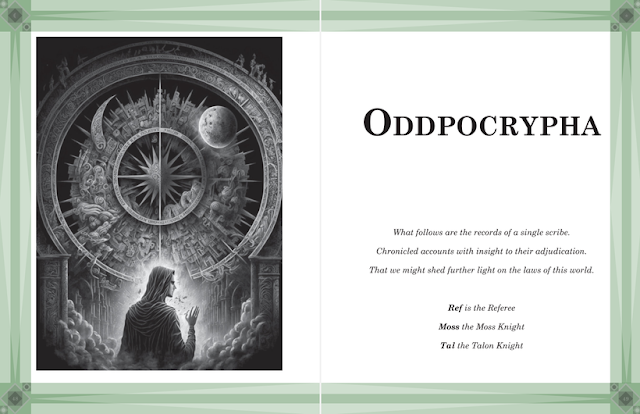
Oddpocrypha

 Oof, was it really four months ago I last wrote about imperfect examples of play?

Well, I'm finally putting it into practice.

I've got this thing about making my games a self-contained book that doesn't need any additional support. Of course, with RPGs it's common practise to mine ideas from dozens of books and blend them together, but I like the idea that somebody could pick up one of my games and feel like they have everything they need in a single volume.

Rules are the easy part, but I also want to make sure that players have good guidance on how to actually run things, and enough adventure content to get things started.

With Into the Odd there's a few pages of guidance for running the game, a short example of play, and an adventure module with a dungeon, wilderness, and small town. The Oddpendium is just a heap of random tables to gesture broadly at the rest of the world. I wanted this to feel a bit like those box sets where you get your rules and adventure all ready to go. Something you can buy one day and feel like you can sit down and run it that evening. 

Electric Bastionland takes a different approach. Here I wanted guidance and procedures over providing specific library content. Sure there are all the failed careers, but I wanted this book to focus on getting people making their own adventures, their own version of Bastionland. It's all about procedures and principles for the conductor to internalise so that the world will eventually start to just flow out of them. The Oddendum is where I can luxuriate in mini-essays talking about the word, the game, and how to run it, in many ways a greatest-hits of my relevant blogposts over the years. It's not as easy to pick-up-and-go as Into the Odd, but my hope was that once it all clicked people would find it easier an more fun to run. 

In approaching Mythic Bastionland I knew I wanted to do something different. Of course the flavour is different, the focus lies in a different style of play, and the rules have been warped, but I also wanted a new approach to how I'd advise the person running the game. Finally, I'm feeling good about the direction of the game now that I've started to work on the Oddpocrypha section, putting the focus on a large bank of examples of play, each accompanied by notes breaking down what happened, why, and how things could have been done differently. 


There are a few in the playtest doc right now, but I'm aiming to have this be a significant chunk of the book.

Here's how one of them might look, followed by the text itself.


CHARACTER CREATION

PLAY

Ref: So in this game you’re both Knights, but you’ll have different strengths and weaknesses. Start by rolling your Ability Scores. They’re Vigour, Finesse, and Charm. For each you’ll roll a d12 and a d6 and add them together. High is better, 10 is average. 

Hands a character sheet to each player. They start rolling their ability scores. 

Tal: Okay, so I got Vigour 11, Finesse 14, Charm 7. 

Moss: I got Vigour 6! Urgh. At least my Finesse and Charm are higher, 10 and 12. 

Ref: Yeah that’s pretty bad! Don’t worry though, just means you’ll need to be crafty and not rely on brute force. The scores might get better later too as your character ages. There’s this rule where… Actually, scrap  that for now. You need to roll d6 for your Guard. This is how good you are at avoiding getting hit or taking lasting damage. 

Tal: Okay, 3, I guess that’s okay.

Moss: I got 6! Guess I’m crafty like you said. 

Ref: Okay now you each get to be one of these Knights.

Ref fans through the book, showing some of the entries for Knights.

Ref: The book says you can choose from here or roll. What do you think?

Moss: Obviously we should roll.

Tal: Oh I dunno, I don’t want to be stuck with a character I don’t like.

Ref: Okay how about we roll, but if you hate what you get then we’ll just choose instead. 

Tal: Yeah, thanks. 

They both roll Knights, getting the Moss and Talon knights. 

Tal: I get a bird? I’ll stick with this one!

Ref: Great, so this gives you some gear and a special thing you can do. Let’s get it onto your character sheets and we can get started. 

THOUGHTS

When getting the players started with the game I like to get them rolling their character as soon as possible, before I even start telling them about the world. The things they discover in making their character will get them immersed in the world right away.

It’s good that Ref gives a bit of context for Ability Scores. If you’ve played a lot of RPGs it’s easy to assume that everybody will work out the average of d6+d12, but just telling the players that 10 is average gives them a point of reference for their character.

Getting bad rolls here can be disheartening, so it’s good to see Ref reassuring Moss that their low Vigour score isn’t going to make their character useless.

We can see that Ref almost goes into explaining the rules for characters ageing, and how their Ability Scores can increase, but decides not to overload the players right now. At this point it’s enough for the players to know that their scores can change later, they don’t need to know the details while they’re focused on their character in the here and now. 

On our very first example, Ref is already breaking the rules. The character creation process says nothing about letting the characters roll a Knight and then decide whether to keep them or roll a different entry instead, but Ref sees that Tal is feeling anxious about getting a character they don’t like and decides to give the players the best of both worlds.

Ref could have stood firm, insisting that Tal either rolls a character or chooses one, but instead Ref took the chance that Tal would probably be happy with their character, but would appreciate the backup option if they didn’t like the Knight they rolled.

This can go the other way, with some players finding it too much choice to be handed a list of 72 Knights to choose from, so would rather take the roll. A huge part of the Referee’s role is sensing the best option for their group. If in doubt, just ask the players and trust them to be reasonable. 

TEACHING THE RULES

PLAY

Tal: Okay, now the rules?

Ref: So this is a bit more complex than Into the Odd, but the core is the same. Wait, were you both here when we played that?

Tal: Yeah I think I remember all the rules.

Moss: Wait, no, I missed that week.

Ref: Okay I’ll start from scratch then. When you do something risky I’ll ask you to roll a Save, so you’ll roll a d20 and try to get equal or less than the Ability Score. So Moss if you made a Vigour Save you’d need to roll 6 or less on a d20.

Moss: Got it.

Ref: Combat is… you know what we’ll deal with combat when it happens. For now you just need to know that the die type next to your weapon is the die you roll when you attack with it. So Moss your Cudgel does d6 damage. Oh, and you have a Shield which gives you Armour 1, meaning you’ll take 1 less damage from attacks against you.

Moss: Right. Does my bad Vigour score make my attacks weaker too?

Ref: No actually. There are times in combat when it will matter, but it won’t affect your attacks.

Moss: Oh right, that’s good then.

Ref scans over some of the other pages of rules  and prepared notes. 

Ref: Yeah the rest we’ll just deal with as we get to it. I’ll give you plenty of warning so I won’t just drop a horrible rule on you!

Tal: What are these things on my sheet? I’ve got Burdens and Feats.

Ref: Right, right. Burdens are bad, you don’t want to have them but sometimes you’ll get them! We’ll deal with them when they happen. Your Feat is a special thing that only you can do. There are some other ones linked to combat but… you know what let’s just get started and we’ll do a little combat brief when it happens. 

Moss: Sounds good, let’s go. 

THOUGHTS

Here I’ll show my bias toward getting the game started as soon as you can, backloading as much of the rules explanation as possible.

The game is designed in such a way that players don’t need to know all of the rules to begin with, but there are some important considerations with this approach.

Players may be relieved that they don’t need to learn rules immediately, but some may worry that they’re going to make a critical mistake without knowing all of the details of how the game works. 

Here Ref starts with the bare minimum, explaining how Saves work. This is a nice rule to start with as it’s very simple and gives further context for the information on the players’ character sheets. They get a little bogged down talking about weapons and armour, and frankly I think Ref could have skipped this whole section, sticking to the line that combat will be explained when it happens. 

It’s natural for players to ask about other parts of their character sheet that they don’t yet understand, here the Burdens and Feats. Ref could have just said “we’ll deal with that later” but here I like that they at least gave the context for those things, if not the actual rules in detail. Now Tal understands what those things are, but hasn’t needed to learn exactly how they work in game terms. 

Something that Ref missed here is explaining the objective of the characters. In this game the Oath gives Knights a very clear purpose, so I would encourage Ref to at least explain the Oath and warn the players that they’ll be judging themselves on their adherence to it at the end of the session. 


The conversational style of writing is a tricky one, and the potential for cringe is high, but I'm hopeful that I can make this into something useful for potential referees. 

 -----------------------------------------------------------------------------------

This post was originally sent as a reward to all Patreon supporters, and is released freely on this site the week after its original publication.

If you want to support my blog, podcasts, and video content then head over to my Patreon. 

Wednesday, 22 March 2023

Universal Creature Profile

It was fun playing around with another type of Universal Profile last week, so let's keep it rolling. Can we make this work for creatures?

UNIVERSAL CREATURE PROFILE
Roll 5d6, drop the highest, then read the remaining dice in order as:

Bone: How much hard structure does this thing have?
Flesh: How much soft stuff does this thing have?
Senses: How acute are its senses?
Brain: How intelligent is it?

1=1: A Bit
2=2: Some
3=3: Lots
4=N: Null, actively none, perhaps by design
5=H: Hazardous, not through lack or excess but the nature of the thing
6=S: Super, off the scale. Think big then go bigger.

EXAMPLES

32H2 - Chitinous bug creature. It hijacks the senses of nearby creatures, severely limiting the victims own senses during this time, causing permanent damage if the bug isn't hunted down and driven out of the victim's head. 

211H - Scrawny little wretches, fumbling around in the light of their hazardous lanterns, but crafty enough to have learned to use local wildlife to their advantage. If you find yourself beset by hostile encounters, perhaps one of these is pulling the strings in the shadows.

HN21 - A monster made entirely of bristling bone spines, tipped with paralysing  venom. Simple minded scavenger that generally wants leaving alone, but won't hesitate to drive away competition for its carrion.

3S33 - Hulking ogre-like creature, as big as their mountain. They understand their realm better than anybody else, but more content to delegate work to their minions while they enjoy the fruits of their success. Frustrated by being surrounded by idiots. 

-----------------------------------------------------------------------------------

This post was originally sent as a reward to all Patreon supporters, and is released freely on this site the week after its original publication.

If you want to support my blog, podcasts, and video content then head over to my Patreon. 
Wednesday, 15 March 2023

Universal Borough Profile

I've had a week off, enjoying/surviving Paris, one of my favourite cities to visit. To go full cliché, it's a city of many halves, each one beautiful and terrifying in its own way. Shades of Bastion everywhere. 

Looking back at my Universal Hex Profile, let's see if we can refit it to generate a Borough of Bastion. 

UNIVERSAL BOROUGH PROFILE - THE FOUR Cs

Roll 5d6, drop the highest, then read the remaining dice in order as:

Climb: How wrecked are your legs after a day walking here?
Code: How screwed are outsiders without a guide?
Crush: How tightly packed is everyone/everything?
Crap: How much filth is lying around?

1=1: A Bit
2=2: Some
3=3: Lots
4=N: Null, actively none, perhaps by design
5=H: Hazardous, not through lack or excess but the nature of the thing
6=S: Super, off the scale. Think big then go bigger.

EXAMPLES

S132 - The ultra-vertical high-stacked Borough taken to its extreme, pushing through the smog and the clouds, mostly welcoming for the tightly packed crowds of tourists, leaving piles of rubbish in their wake. 

3NN3 - Residential buildings and heaps of industrial waste both piled high, but now walled up as an insurance write-off. Nobody can live here anymore, and visitors only permitted under armed escort. Any valuables found within are used to help pay off the Borough's debts. Perhaps one day it'll break even again. 

H212 - Built on the broken ground of a failed urban mine, getting from one street to another often requires ropes and spikes. Because of that, most of the residents came from mountainous regions of Deep Country, bringing their spiky dialect with them. Not much in the way of public services, but nice to escape the crowds. 

311N - Concentric spirals of paved steps, or funicular if you can afford it. The streets are clean, spacious, and well signed. When you see a Borough like this you have to ask why more people don't live here. Cost might be a factor, but there's usually something more sinister too.

-----------------------------------------------------------------------------------

This post was originally sent as a reward to all Patreon supporters, and is released freely on this site the week after its original publication.

If you want to support my blog, podcasts, and video content then head over to my Patreon. 

Wednesday, 8 March 2023

Rolling Back a Decade

This week's post has been largely replaced by being away on holiday. I'm back now but putting things up a week early on Patreon really messes with the post-time continuum. 

So while I'm (not) away, let's break time even further by travelling back ten years, when Into the Odd was being playtested, unaware of its bright future. 

Two old posts condensed into one. 

In Favour of Static Saves

You might notice a big change in the current edition of Into the Odd.

Saves are now "roll equal or under the appropriate stat". Nothing modifies this roll.

Here's my reasoning.

I want players to be fully informed of the risks they take.

A character with DEX 7 now knows that they'll have to roll 7 or less on a d20 to pass a DEX Save. No matter what. They won't be asking you what number they'd have to Save against when considering their actions. All the data they need to make an informed choice is on their own character sheet.

The game advises Referees to warn players when their actions will lead to a Save. Saves occur as a result of a choice or action.

These factors should combine to make the DEX 7 player do whatever they can to avoid DEX Saves. No leaping across that pit unless it's a safe jump. Better yet, let's find a way to bridge the gap or go in another direction.

The changes should also eliminate the unpleasant surprise a Save can bring. Imagine this.

A STR 12 character is fighting a corrupt guard. They take a big hit, run out of HP and find out their opponent has STR 17.

The Referee said the guy looked burly, but STR 17?

Using the old system, the player must now roll 15 or more to avoid being incapacitated and possible killed. I love deadly combat, but this could come out of nowhere.

I don't want players to be thinking about the STR score of their opponents or working out probabilities during combat. Having static Saves greatly reduces the amount of numeric data you're factoring into the decision and lets you focus on the situation.

D&D was pretty close to having static saves all the way up to third edition, and that seemed to work just fine. Of course, saves were often modified for tougher circumstances, which I won't be doing.

So, let's get this straight. A STR 10 character has a 50% chance to avoid Critical Damage from both a stick-waving street urchin and a Timeless Horror from Beyond?

Yes.

The Urchin is beating his stick for d4 damage. He has a handful of hp and you can knock him down without much thought.

The Astral Horror is lashing out for d12 damage, warps your form into a tortured abomination with each hit and constantly barrages you with mind control effects. Your swords and bullets glean off its shadowy hide, turning your weapons ice cold. Even if you find something that can hurt it, it has dozens of hp and is going to make a few Saves before you can bring it down.

I'm not worried about the Astral Horror not being scary.


Why Don't I Get Better At Fighting?

For the mundane Into the Odd character, not interested in Arcana, you hit a peak of offensive ability quite early on.

Get yourself a set of Modern Armour and a Field Weapon. Congratulations, you're dishing out 1d6+1 damage and ignoring a point of damage against you from each attack. That's about as good as things get. No, you don't get an attack bonus as you level. No, your high STR doesn't give you a damage bonus. No, you don't gain feats and powers.

Sucks, right?

What advancement really does is give you the opportunity to fight smarter. There are a few ways this works. 

  • You have more hitpoints, letting you stay in the fight for longer. You can't fight if you're dead.
  • Your Ability Scores will increase a little. This lets you pass Saves to avoid nasty monster effects and makes risky combat manoeuvres more viable.
  • If you're on a battlefield, and of any real importance, you should be on a horse. The armour and damage bonus here is quite a big deal.
  • You've been gathering riches this whole time. Even if you don't carry your cannon everywhere, you might have a small army or a galleon that can fire broadsides at your more persistent enemies. At the very least you should know when to take your elephant gun, fire oil and bombs with you on expeditions.
  • Even if you aren't using Arcana to cast Spells, you'll have gathered a bunch of weird stuff along the way. You have a potion that turns you into the Hulk, a thermal detonator and a glass jar containing some sort of intelligent lightning bolt. When things get tough, each one of these could save you. 

These are all very deliberate design decisions. One of the main goals of Into the Odd is to take the focus away from the character sheet. There really isn't much on there. Three Ability Scores that you only use for Saves, your hitpoints, and a bunch of gear. 

But you want to be Legolas with Flintlock Pistols, blasting away dozens of foes each turn. I'm not saying you can't make your mark on the battlefield, but it isn't all about damage output.

Legolas was only able to fight like that because he had five times the hitpoints of Joe Averagelf and rolled well on his STR and DEX scores. Joe can stab an orc with twin daggers just as easily, but gets an axe buried in his back on the next turn. Legolas has the luxury of surviving long enough to look cool before shield-surfing to safety. He's grabbing a short rest off-camera while his hp recover.

Shooting guys with his bow while he shield-surfs? Good job he has such a high DEX, or he'd have found himself plummeting into the orc horde for trying something so stupid.

Advancement in Into the Odd doesn't give you huge damage output and cinematic combat abilities. It gives you the survivability that you need to be able to act heroically.

Just remember, you're still going to fail Saves. Is climbing on top of the elephant really worth what will happen if you fall down into the beast's path?