Thursday, 22 September 2022

Shame and Hatred

A sidestep from game content today. 

A year ago I wrote about the experience so far of working full-time on games. Everything in that post still applies, but with another year under my belt I thought a little more self-reflection could be interesting. 

I've now been working on games full-time for two and a half years, with six years or so before that somewhat earnestly making games in my spare time. It's been a good year, so I'm pretty confident saying that I can keep doing this for now.

I hold up Honesty and Authenticity as standards I expect from myself and from others. In short, I think people should tell the truth and be themselves wherever possible. 

So let me live by those values and bare my shame and hatred for all to see. 

SHAME - The Backburner

I keep most of my work notes on a Trello board. Among others there's a list of Live Ideas and the Backburner.
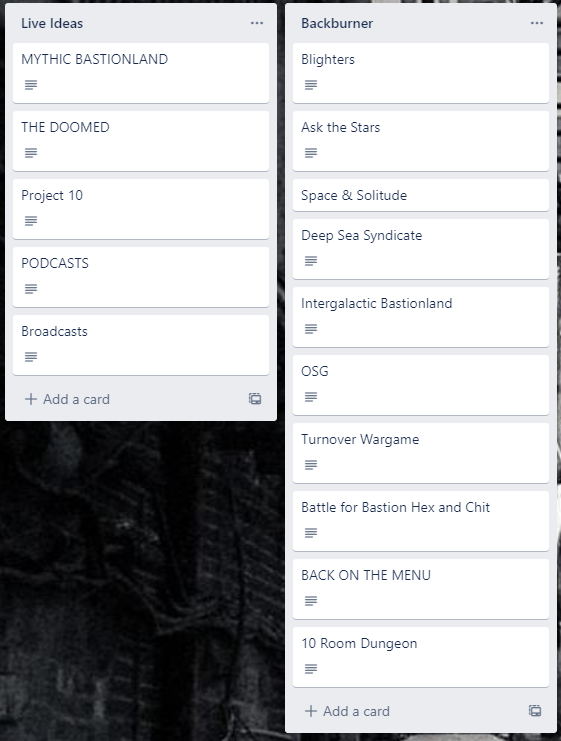


Now it's easy to imagine Backburner as a euphemism for Bin but it's really not. Maybe one or two of them are getting close to rubbish, but the rest all have ideas that I revisit now and then. 

They vary from highly fleshed out (Blighters, Space & Solitude) to barely more than a vague idea (BACK ON THE MENU, Battle for Bastion). 

It would be easy to look at this list, add up the hours I've spent thinking about them, writing, rewriting, testing, and cost it up as a business loss. I've certainly felt that way at times.

But I no longer fear it. The backburner serves a purpose. Ideas can be repurposed, mechanics stolen, and some projects may rise to the Live Projects board again. 

The Doomed started as GRIMLITE, which I never expected to be played by anybody but me, and pretty soon I'll have some news on the exciting future of that game.

The backburner is not a thing of shame. It is a thing of pride. 

HATRED - Twitter

I hate it. 

I hate the type of conversation that it encourages. I hate the way it makes people perform, people who don't perform that way elsewhere. I hate that it makes me think about people I shouldn't be giving headspace to. I hate that it feels like it's become the online hub of RPGs. 

Most of all I hate that I hate it. I know others feel the same, but it also feels like the problems above have a direct wire into my brain. I should be able to rise above them, but I can't. 

If I just had a personal account I'd be long gone, but doing so would be a business decision now, so I'm still there, or rather Bastionland Press is still there. 

I unfollowed everybody a while back, so I essentially have no timeline to scroll through. This helped. 

There are a handful of people I enjoy keeping up with, so I manually visit their timelines now and then, like how I used to know the phone numbers of my best friends. 

Unfortunately there are other people my brain won't let me forget, so I sometimes find myself checking in on them. Are they posting something terrible? Are they arguing with somebody about something ridiculous? Are they just yelling out for attention? I don't know why I can't ignore them, but I said this post was about honesty didn't I?

At least I'm good at not publicly engaging with that side of things.

There are good elements. The vast majority of times I get tagged it's something worthwhile, so I still look at my notifications and reply or retweet as appropriate. DMs are a handy way of contacting somebody new for a podcast or collaboration. Occasionally I forget myself and post some dumb thing and I get some funny replies. It can be fun. 

I just wish the good stuff was happening somewhere different to the bad stuff. The stuff I don't want to be associated with. The stuff I don't want to feel like I'm legitimising by staying there. 

Of course there are alternatives. You're reading this post on one of them (Patreon or Blogger). For conversation and link-sharing I love Discord, though I've limited myself to just five essential servers. 

Last week I started a mailing list. I whisper to myself that if my email subscribers outnumber my twitter followers then I'll delete the latter, but I won't. Maybe mothball it, but I fear the damage is done. The problems I have with twitter won't be solved by me leaving it, but I do hope I can continue the non-total transition to other platforms. 

This one won't be shaken off as easily as my shame. It's here to stay. 

 -----------------------------------------------------------------------------------

This post was originally sent as a reward to all Patreon supporters, and is released freely on this site the week after its original publication.

If you want to support my blog, podcasts, and video content then head over to my Patreon. 

Thursday, 15 September 2022

Universal Hex Profile

Earlier this year I wrote about my first dip into Traveller, but I didn't get onto talking about the Universal World Profiles and Universal Personality Profiles.

In short, it's a code you learn so that you can see B785457-C and know that it means: good shipyard, 7000 mile radius, dense atmosphere, 50% water, tens of thousands of people, feudal technocracy, shotguns permitted, and average imperial tech level. 

I worked through the process on this stream and said that I'd love to mess with the system to try a simpler approach. 

Which I did! But then I neglected to post it here, so let's dig back into it with a few tweaks. 

This works for planets or regions, but I'm applying it to Hexes here because they're at the forefront of my mind right now. 

UNIVERSAL HEX PROFILE - TWEI

Roll 5d6, drop the highest, then read the remaining dice as: 

Topography: Verticality of terrain.
Water: Wetness.
Ecology: Non-human life.
Infrastructure: Buildings, road, other human stuff. 

1=1: Trace
2=2: Some
3=3: Lots
4=N: Null, actively none, perhaps by design
5=H: Hazardous, not through lack or excess but the nature of the thing
6=S: Super, off the scale. Think big then go bigger. 

So 1-3 represent your "normal" levels, with 4-6 representing more exceptional results. If your brain works like mine you can tell yourself that, if using a d6 with pips, the results for 4, 5, and 6 kinda look like N, H, and S respectively if you imagine a load of lines and really want it to work. 

If you want fewer exceptional results then add more dice to the pool, but only keep the four lowest. Likewise, if you want more wackiness then just roll 4d6 straight. 

Examples

12HN: Flat planes with winding rivers and lakes, nasty predators, totally forbidden to enter.  

3N21: Utterly dry mountains, herds of goats, a few trails and the odd hut serving as a vital water supply.  

21SS: Hills, damp ground but no bodies of water, overrun with fungus, huge industry being built to harvest them.

H3NH: Quicksand-like bog, all wildlife wiped out by its toxicity, jealously guarded by hostile inhabitants. 

If we go back to the planetary idea then I guess present-day Earth is 2333

-----------------------------------------------------------------------------------

This post was originally sent as a reward to all Patreon supporters, and is released freely on this site the week after its original publication.

If you want to support my blog, podcasts, and video content then head over to my Patreon. 

Friday, 9 September 2022

The Bastionland Presser

Better late than never, I'm building a mailing list where people can keep up to date with everything happening at Bastionland Press.

Expect an irregular digest of my normal stuff with a little extra now and then.

Go and sign up at https://bastionland.substack.com/


EDIT: I messed up the url but it should work now!

Thursday, 8 September 2022

Heroism

Psst, I'm not actually here right now, so it's just a short one this week.

When I sit down to play an RPG, I'm usually happiest when the following things are present:

  • Solving problems with tactical infinity
  • Exploring an interesting world
  • Seeing a story emerge as a result of our own actions

Into the Odd and Electric Bastionland were designed with these in mind. Mythic Bastionland has some key differences, but I still want to keep those three things in focus.

One of the thorny issues at the moment is how the idea of the players being Knights interacts with that first point about encouraging creative problem solving. 

Knights

The desperate treasure hunters of ITO and EB might start with some novel equipment, but their success usually relies on that tactical infinity I mentioned earlier. Coming up with a scheme to survive the dangerous world despite their limitations.

Do heroic knights need to indulge in such trickery? 

The characters of Mythic Bastionland are framed as being more competent. They're knights after all. They have  a cool knight-name, a steed, and the people of the realm are often glad to see them ride into town. 

They even have special combat Feats they can perform! It's easy to see how they can be read as heroes right from the off. 

Yet you start with no Glory. Your rank is Petty Knight, considered unworthy to lead a warband or have a place in court. You don't have a sword, and you likely don't have proper armour. Even at peak performance you won't become Noble, worthy of a holding, for an entire year. 

I want them to feel a different to the failed professionals of Electric Bastionland, but I still want them to feel vulnerable, and rely on clever problem solving as much as martial power. I want them to do great things, but I also want them to fail. 

Projecting the right presentation of Knights throughout their career is something I'd like to work on in future revisions of the playtest. At the moment it's not quite there, and can create some strange moments.

Strange moments can be good, and create memorable decision points for the players, but they shouldn't be swimming in cognitive dissonance the whole time. 

-----------------------------------------------------------------------------------

This post was originally sent as a reward to all Patreon supporters, and is released freely on this site the week after its original publication.

If you want to support my blog, podcasts, and video content then head over to my Patreon. 

Thursday, 1 September 2022

Primacy of Action

In Mythic Bastionland I talk about the Primacy of Action.

PRIMACY OF ACTION

Even when using the rules for travel, exploration, and combat, remember this, the most important thing

No rule or system within the game should devalue the Actions the players take.

Remember the core of giving players information, honouring their choices, and describing the impact of their actions.

This has some similarity to the Fiction First concept found in many games. I'll avoid trying to define that one too closely, as others can't seem to agree fully.

I'd probably apply this to all of my games, but I wanted to stress the point in Mythic Bastionland because there's a much larger focus on procedures. These are meant to be tools to allow the GM to emulate a living world, not a rigid programming code to a clockwork nightmare outside of the players' control.

I almost called it Primacy of Past, as I want the group all know that previous established facts get priority over the usual procedures of play, but really even present Actions should carry certain weight above the mechanical processes. 

The players always have choice, but they must live with their actions, for better or worse. 

Normally the group is considered to have Supplies. While travelling they might get a result that says "today's supplies are the last", so the following day they have no supplies. 

It might seem obvious, but player action can deplete supplies before this roll calls for it. That roll is a tool to account for the passive consumption of supplies in a level of (low) detail that I feel is appropriate for this game. Let's say they meet another travelling group of knights in the woods and offer to cook them up a feast and share a camp. The GM might say "you can do that, but you'll leave yourself low on supplies, tomorrow will be the last". As this all came out of player action, this feels fair. 

So a few days later the group are out of food.  A typical way to resolve this is using a Task to Forage, which might require a roll depending on their situation. Instead they encounter an Omen that describes a lush orchard filled with delicious fruit. If they press into the orchard then of course they can fill up on supplies here without needing a roll, or even performing a Task at all. It's right there, assuming nobody minds you taking it...

When it's a call between protecting the impact of player action, and protecting the authority of the game rules, I'd choose the former wherever possible. 

-----------------------------------------------------------------------------------

This post was originally sent as a reward to all Patreon supporters, and is released freely on this site the week after its original publication.

If you want to support my blog, podcasts, and video content then head over to my Patreon. 

Thursday, 25 August 2022

Mining for Problems

I don't think I'd ever want to make an RPG without testing it. 

It's not that testing is completely necessary. You can make something and put it out right away, and this might be the only option for some. 

But, if you can, there are huge benefits to be had. Every game that I've tested has been improved by the process. 

So let's take a trip to the experimental ludorium. 

When I'm testing a game I'm looking at a few different areas, but one looms large.

I'm looking for problems. 

Problems, Not Solutions

So there's that corporate mantra which bosses like to use: 

"Don't bring me problems, bring me solutions!"

For playtesting I feel like the opposite is true. Tell the people testing the game to bring you problems, not solutions.

I get the temptation. You've played in a playtest of a new game, and maybe it's already got you excited. It was fun, but there are definitely areas that need improving, and you've got some really cool ideas. They should add this thing, or change this rule to work a different way. 

I can only speak for myself, but personally I don't find this useful at all, and at worst I find it a distraction. 

Sometimes the ideas just don't fit with the goal of what I'm trying to create, sometimes I just don't like them, but the worst are the ideas that I actually like! There the temptation is to add them in, but nine times out of ten the idea doesn't gel with the rest of the game, or the whole thing starts to drift into something I didn't want it to be.

For me, the best feedback is "here's a list of problems I had with the game".

Now I'm only human, so I love getting a list of things they like, and a huge list of problems can feel like a gut punch, but we're here to do the difficult stuff, right? We don't want to make any old game, we want to make it good.

Imagine you get this list back:

  • I wasn't really sure what my character was supposed to do
  • The rules for how you level up felt confusing
  • I don't know why you'd ever choose to wear armour, it feels like it makes you more vulnerable

Now one part of your brain yells:

  • Look, you go searching for treasure you idiot, it's right there in the first line of the game
  • It's waaaaay simpler than other games, so you must have just not been paying attention properly when I explained it
  • No I've obviously tested the numbers on this and have attached a formula to prove that armour makes you 32.33 (repeating of course) percent tougher

And another part screams:

  • Oh, right, well I've added an Objective system now so each character always has 3 Goals they're trying to achieve and when they tick them off they get 1 point toward their Progress Tracker
  • I've stripped this down now so you just level up at the end of each session no matter what, I'm so sorry
  • Armour now offers double the previous protection against all weapons and immunity to unarmed attacks

But instead, say thanks for the feedback, and let them know it's been noted. Add it to a collated document of feedback and go do some more tests if you can. 

Remember you can add to this list of problems! Maybe in running the game you got tired of flipping between distant pages, or you kept forgetting a certain rule existed. GM problems are also valid, throw them on the pile. 

A little later, when you sit down to work on the game, open the feedback document and look at the problems. Look for patterns. Take everything on board, but take nothing as gospel. Condense the list down to a few overarching problems if you can.

Then go to work on them with your own solutions, in your own voice, remembering the vision you have in mind for your game.

Their problems. Your solutions. 

 -----------------------------------------------------------------------------------

This post was originally sent as a reward to all Patreon supporters, and is released freely on this site the week after its original publication.

If you want to support my blog, podcasts, and video content then head over to my Patreon. 

Thursday, 18 August 2022

System as Shock

This whole post might be stating the obvious, but it's something that's been bouncing around my head a bit.

You don't need a system for your RPG. A group can sit down and rule things by consensus, or under a lone arbiter. 

What's in the cave? Maybe it's what I planned before the game, maybe it's what makes sense in the current context, or maybe it's the best idea that the whole group can think of.

I stab the dragon! Hmm, maybe you're right that this sword couldn't possibly hurt it. But wouldn't it be cool if it did? Let's work it out. 

Of course, whatever arrangement we have in place at this imaginary table is a system, but for this post I'm talking about the specific type where there are written rules and procedures that exist independently of the people at the table.

Randomness is a part of it, but also procedures like dungeon stocking do their part. Anything where the GM can point to the book and say "hey, I can't take credit/blame for what just happened!"

Alongside the players it contributes to the game, almost like an extra person sat at the table. 

And for me, a huge part of the appeal is the element of shock. 

I've been surprised by other players at the table, and by revelations from the GM, but I've only ever been shocked by contributions from the System.

Here shock isn't innately a good or bad thing, but it's always impactful. A deeper, more intense flavour of surprise, where something is truly unexpected, often forcing an urgent or complex response.

That goblin scoring two critical hits on the barbarian. That Purple Worm encounter on the first level of a dungeon. That friendly reaction roll from a hideous monster. 

These could have come from player or GM input, but in my experience those twists don't quite carry the same weight, and can sometimes feel arbitrary.

Nothing shocks like system. 

-----------------------------------------------------------------------------------

This post was originally sent as a reward to all Patreon supporters, and is released freely on this site the week after its original publication.

If you want to support my blog, podcasts, and video content then head over to my Patreon.